P: +6017-450 7187
E: cw.lim@la-feeder.com
P: +6017-450 7187
E: cw.lim@la-feeder.com
P: +6017-450 7187
E: cw.lim@la-feeder.com


Efficient material handling is essential for Malaysian industries such as manufacturing, food processing, construction, and recycling. One of the most critical pieces of equipment in bulk material management is the elevator hopper. By ensuring smooth, consistent, and reliable transfer of materials, elevator hoppers improve productivity and reduce downtime.
However, selecting the right elevator hopper in Malaysia requires careful consideration to match your facility’s specific needs. In this article, we explore 6 key factors to consider when choosing an elevator hopper and why proper selection is crucial for operational efficiency.
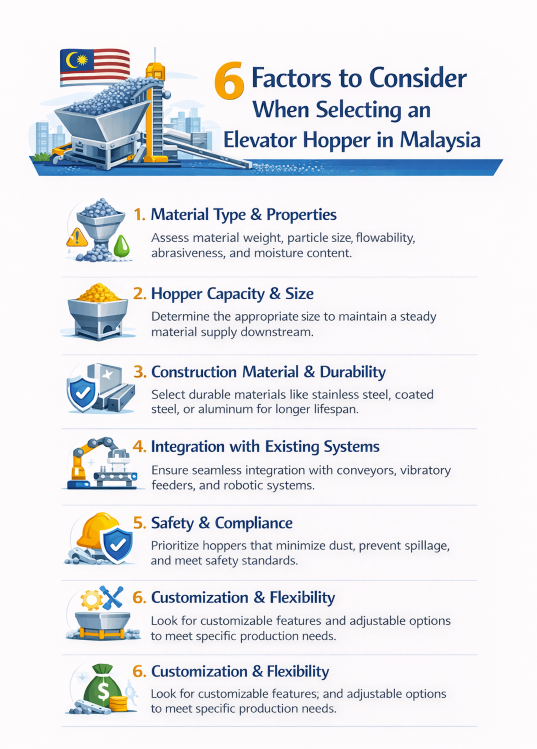
The first factor to consider is the type of material you plan to handle. Different materials have varying characteristics such as:
For example, handling fine powders requires a hopper with smooth surfaces to prevent clogging, while heavier aggregates need robust construction. Choosing an elevator hopper that matches your material ensures consistent flow and prevents operational interruptions.
Elevator hoppers come in different sizes and capacities. Selecting the right size is essential to:
For Malaysian factories with high-volume operations, a larger-capacity hopper may be necessary to reduce refill frequency, while smaller operations can benefit from compact designs to save floor space.
Elevator hoppers must withstand the rigors of industrial environments. Consider:
A high-quality hopper ensures reduced maintenance costs, longer lifespan, and reliable performance in Malaysian facilities.
Modern production lines often use automated conveyors, feeders, and sorting systems. Your elevator hopper should integrate seamlessly with:
This ensures smooth material transfer, prevents bottlenecks, and supports automation initiatives in Malaysian factories.
Industrial safety is a critical consideration. A well-designed elevator hopper should:
Choosing a hopper that meets local safety standards helps protect workers and ensures compliance with Malaysian industrial regulations.
No two production lines are identical. Some facilities may require custom features such as:
Opting for a customizable elevator hopper ensures long-term adaptability and efficiency in your Malaysian operations.
Selecting the wrong elevator hopper can lead to costly downtime, reduced efficiency, and increased maintenance. Here are common mistakes Malaysian manufacturers often make:
When selecting an elevator hopper, the supplier is just as important as the equipment itself. LA-FEEDING offers:
Partnering with LA-FEEDING ensures your elevator hopper performs efficiently and supports long-term operational success.
Selecting the right elevator hopper in Malaysia requires careful attention to material type, capacity, construction quality, system integration, safety, and customization. By considering these six factors, manufacturers can optimize their bulk material handling processes, reduce downtime, and improve overall production efficiency.
Investing in a high-quality elevator hopper from a trusted provider like LA-FEEDING ensures your facility remains productive, safe, and competitive in Malaysia’s rapidly evolving industrial landscape.
An elevator hopper in Malaysia is used for storing and transferring bulk materials efficiently within industrial production lines. It ensures consistent material flow to conveyors, feeders, or automated systems, helping manufacturers improve productivity and reduce downtime.
To choose the right elevator hopper capacity, consider your production volume, material type, and space availability. High-volume operations may require larger hoppers to minimize refilling, while smaller facilities can benefit from compact designs that optimize floor space.
Common materials include stainless steel, aluminium, and coated carbon steel. The best choice depends on the material being handled, environmental conditions, and durability requirements. Corrosion-resistant materials are ideal for long-term industrial use in Malaysia.
Customization ensures the hopper matches specific material characteristics, discharge requirements, and automation systems. A customized elevator hopper improves efficiency, reduces blockages, and supports seamless integration into existing production lines.

I am text block. Click edit button to change this text. Lorem ipsum dolor sit amet, consectetur adipiscing elit. Ut elit tellus, luctus nec ullamcorper mattis, pulvinar dapibus leo.